Georeactor Blog
RSS FeedClaude and GPT's high-protein diet
Arrival of 3 natural language + protein LLMs
On November 16th Xinming Tu made a blog post Claude was trained on protein sequences at scale about off-the-shelf Fable 5.2 and Opus 5.5 having a surprising understanding of amino acid sequences (example MANLGCWMLVL…). Although these are natural language models, they could continually predict the next amino acid in a sequence, and they react differently to shuffled, unreal sequences. Their prediction abilities are on par with purpose-built models trained only on proteins:
Fable 5.2 beats every open protein language model we ran, and Opus 5.5 is level with ProtGPT3–10B
This maybe activated some people at OpenAI to publish, because on the 24th they posted their paper GPT-6 as a Universal Foundation Model for Protei Biology: Beyond Specialized Models (link is to their more accessible blog post). GPT-6.2 and internal models could create binder sequences (designed to attach to a specific protein or molecule), which went through some additional processing by SolubleMPNN, and then were tested in the lab by a partner company (Onava).
Not only do they work, they say
our internal models generally achieve higher in silico success rates than RFdiffusion
[note this paper distinguishes between RFdiffusion and RFdiffusion3]
They've even managed to specify in text which region of the 3D protein they would like to dock with. Having this all rolled into a model which is smart and general-purpose enough to read papers and 'steerable' with natural language instructions is really cool:
Natural language offers the most intuitive and informative way to incorporate relevant conditions: molecular contexts, including binding interfaces, binder shapes, and any conditioning information expressed in terms of molecular structures and shapes…
Note that HuggingFace/NVIDIA had their own Carbon-X model release a month ago where they added 6-mer tokens on top of Qwen3, creating a natural language + DNA model. With a raw DNA sequence you usually want a bidirectional model, so I was surprised? This got less tech press because their examples are classifying some DNA sequences, not generating new proteins or doing lab work. But something interesting is going on there, and I look forward to seeing future releases by HuggingFaceBio.
In January 2024, so almost three years ago, in response to AgroNT I wrote this about genomic language models. And here we are??
It would be neat to have a model with natural language for more context around the task, or explaining influential base pairs in the output (the original paper discusses importance / influence of specific tokens).
Maybe all users are domain experts, maybe a pattern across 6,000 base pairs is not conducive to human explanations, maybe the thought was it's tricky to bolt this onto a LLaMA-like natural language model.
Analysis
Oddly Xinming Tu's method found no recognition of proteins in GPT-6.2, on the 20th adding the update: "GPT-6.2 Sol and Astra show no sign of it either."
My best guess is there is some aggressive post-training, filtering, or routing going on to prevent the average user from generating a viable protein. I'd noticed some weirdness earlier on OpenAI's closed-access biology program, GPT-Rosalind:
GPT-Rosalind-6 uses the same weights as GPT-6 Astra, our flagship reasoning model
…though at the time I assumed this meant that GPT-Rosalind was answering strictly natural language questions and not designing proteins!
Hacker News is so-so on bio LLM stories, but this comment on the OpenAI post from an expert (with previous work at the UW Institute for Protein Design) is top notch and covers most of what I was thinking or planning to pull together for this:
Makes total sense that they'd be working on this, it's something we discussed in the lab as well as the likely future of this work - true integration of the language modeling capabilities with proteins, natively multimodal like it's done with images. Five years ago we laughed at people with galaxy brained ideas to train / fuse a protein and natural language model, advertising this idea of "give me a natural language request and the model spits out the sequence that does the thing". There are many objections - the annotated data is not there, trying to pose everything as a language modeling objective sounded really naive at the time, and there are lots of tasks that are structural/chemical in nature that require inference based on physical and chemical principles, which interpolating machine learning models shouldn't be able to do. Most of these objections still exist, but now we aren't laughing. I do think eventually these models will get there.
[...]
Also binder design is basically the easiest task, super solved a million times in the past few years, and their designs just made helical bundles, I don't think this is particularly impressive in terms of pushing the frontier.
Indeed the open source model world is saturated with binder design tools most recently RFD4-Proteina, and BindCraft2.
Thinking about what comes next,
- We now know that the OpenAI people are in this game, they can use their existing model training resources (i.e. likely GPT-7 would be better at these tasks), and they are connected to wet labs which will make and evaluate 100+ AI-designed proteins. Very capable.
- We already know that protein models and evaluations are uncomfortable with rare or fully novel sequences. If GPT-Rosalind has read human language, code, and a lot of repetitive human and E. coli proteomes, and then every known potato virus, the model likely won't know much about potato viruses.
- Part of the reason that AgroNT and now HuggingFace Carbon-X are interesting is that they read the whole genome, not just the protein-coding parts? If binders are "the easiest task" then there is a lot left to do in proteins and then beyond. There is information before and after a protein-coding sequence which is relevant to whether it gets transcribed at all.
-
One of the reasons which I backed off from natural language + bio LLMs was that I didn't think it was working? Specifically there were questions if models reading a sequence need help to 'visualize' the 3D structure, if reading in a single direction was limiting causal models.
If we include DNA and "transcriptomes" of specific cells - influential sequences could be thousands of tokens apart or further, and they are not bound by the limits of human languages and grammars which will remain the core training data and post-training focus of OpenAI. If GPT-7+ can compute and reason their way around these problems, awesome, but it might take a lot of tokens to make 100 candidates (which then need additional refinement by SolubleMPNN) compared to existing tools which run in-browser.
But I still feel a little bad for doubting, and it's weird that it's real now.
The road ahead
If you are long on lncRNA, microRNA, or maybe epigenetics, transposons, super-pangeonomes, or gut bacteria, then you know that we have a lot left to learn before anyone has "solved biology".
The example which I need to close with is Heliconius butterflies. Scientists had trouble defining species within this genus because there are multiple morphs within a species, species have converged to mimic others' wing patterns, and there are hybrids. Once costs were low enough to sequence butterfly DNA, one of the main findings 10 years ago was that the cortex gene controlled wing coloring.
In 2024, researchers tried CRISPR knockouts and measuring gene expression and the results did not line up with what they 'knew' about cortex. While experiments had identified the right region of the genome, they now found an overlapping long non-coding RNA (named ivory) being the real influential component. Also some microRNA.
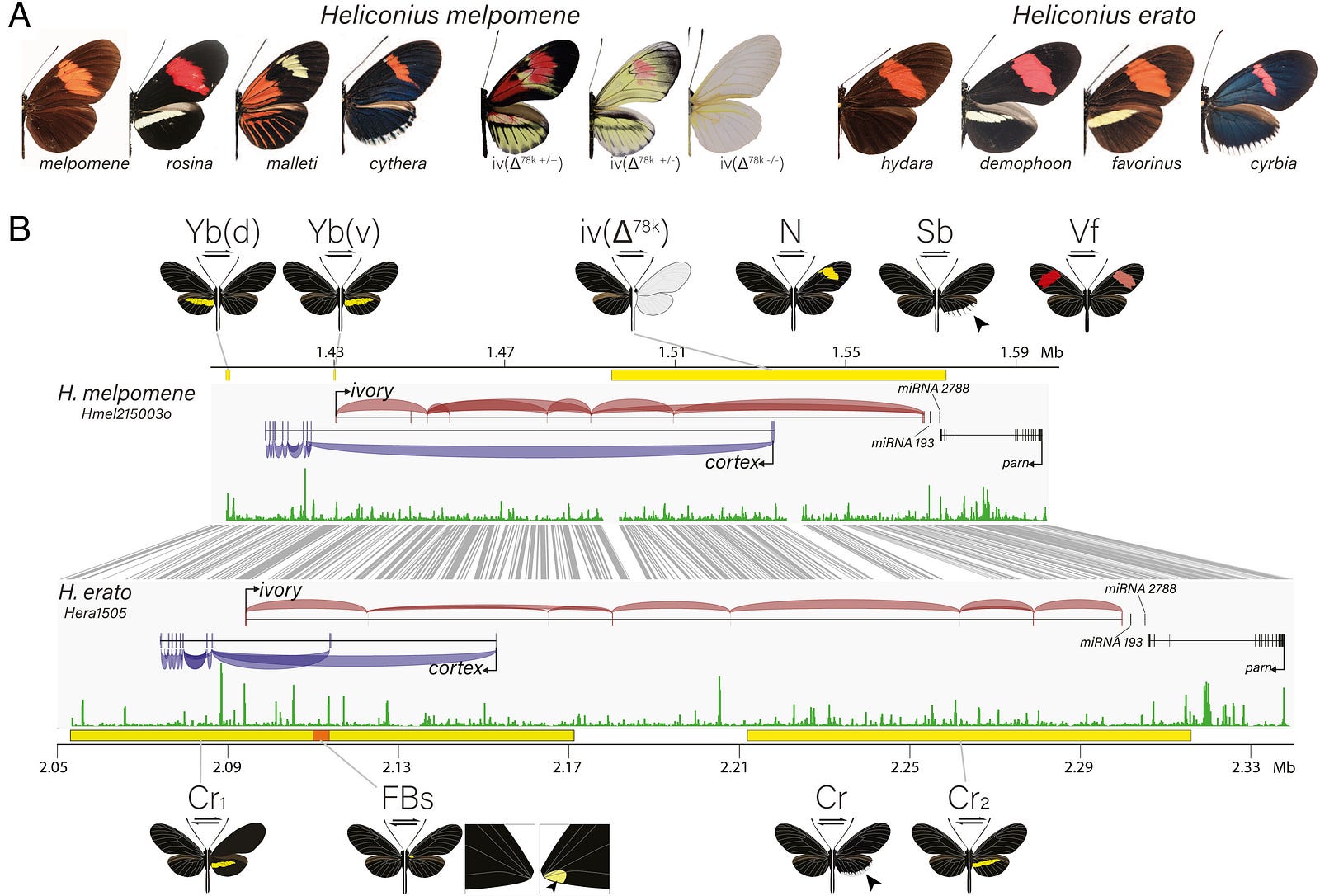
As of 2026, there continues to be some complexity and unknowns there: https://www.nature.com/articles/s41467-026-79315-w
