Georeactor Blog
RSS FeedParklet - a Glacial Development
While visiting NYC, I saw an odd marker on Google Maps. It's a moderately large rock breaking up the street grid in Long Island City, Queens. That cleared space for a pedestrian plaza.
A neighboring brewery writes:
Our address is on a Pedestrian Plaza, permanently shut off to traffic. It's filled with picnic tables, planters, and an 'ancient glacier rock,' about which we know very little, unfortunately
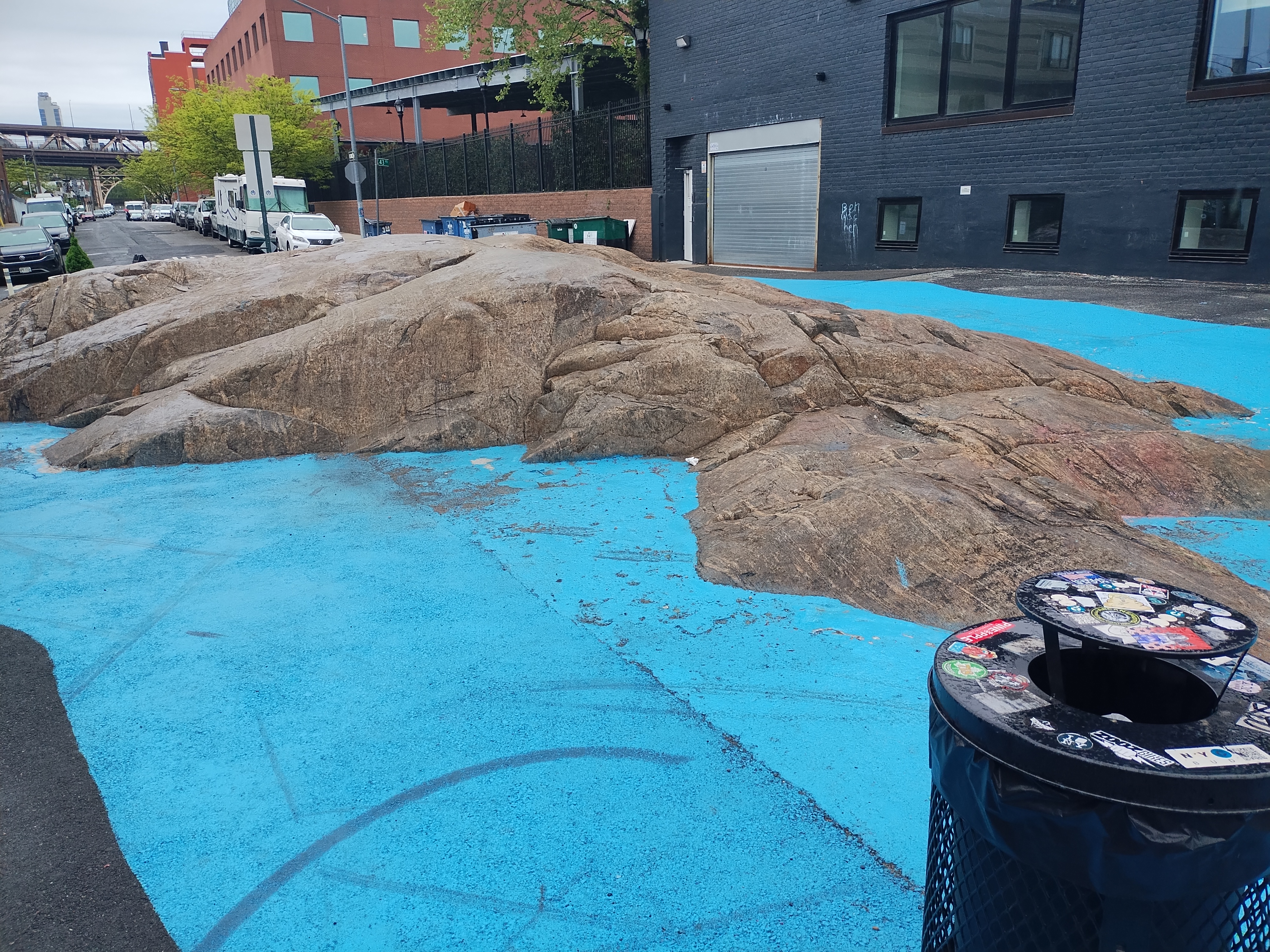
(there are a bunch of picnic tables on the other end, but I wanted to show the rock)
The earliest mention that I could find is a December 2006 press release from New York City's Parks department, when cyclist K. Emmanuel Fuentebella graduated their "Boot Camp for Park Advocates" with a proposal for turning this dead-end parking lot into a "mini-park". I assume we're using this term because it's so soon after the dawn of parklets.
An Epoch Times interview with Fuentebella from 2008 (and these shirts), a 2011 MoMA PS1 neighborhood zine, a 2012 blog post, and Flickr captions of the time all call this "the L.I.C. rock". A rock climbing gym opened in the neighborhood in 2015 and absorbed much of the LIC/rock association. Mentions of the rock enter a lull. It's possible that Fuentebella moved on - mentions in cycling and transit stories also stop around this time.
A long-gone 2012 post on LICSpot identified the rock as a "glacial erratic", like a few others found around the city. By fall 2017 it was on Google Maps likely with its current name "Ancient Glacier Rock" (or "Glacial" on OpenStreetMap). Incredibly, none of the 300 current reviews contain the phrase "LIC rock". Someone tried to create a Wikipedia article for the rock in 2023, but it got merged into the article for Queens Community Board 2. A comment on this Facebook video from last year argued that it is NOT a glacial erratic, but an outcropping of exposed bedrock.
In StreetView images from 2009–2016, cars are often parked on top of the rock. A Community Board meeting in 2019 says the parking was once used by employees of Craig Envelope, and then opened to standard alternate side parking (ASP). The rock was partially walled off for adjacent construction in 2018, so maybe that led to rock revival? The area got shortlisted for conversion into a pedestrian plaza (12th Street Plaza) which opened in fall 2019. There's a bunch of media coverage around that time.
So what can we learn from this?
Long Island City changed a lot in the past 20 years. You can read a lot of discourse around this when they sort-of won Amazon's HQ2 in 2018. Making a disused street with a big rock into a park is a victory for 'new urbanism', but it might be more about the businesses on the block changing.
I feel like we need to send a geologist to LIC. How does this rock have a park and no informative sign about what it is?
