Georeactor Blog
RSS FeedDC Trip
This week I had planned for two days in DC, and after my flight got moved, ended up with one. I managed to visit the National Geographic Museum of Exploration (brand new), Lincoln Memorial Undercroft (reopened after almost 40 years), and the Smithsonian Air & Space Museum (renovated in time for their 50th anniversary on July 1st).
After working with a DC-area client in early 2019 and a quick visit that fall, I haven't had a chance to return to the city. The subway got tap-to-pay about a year ago. GWU is covered with stickers about politics of the day. Coinbase was on the street making a video about phishing scams.
In reverse chronological order:
NatGeo
National Geographic used to have some objects on display at their headquarters office, which I visited for an OpenStreetMap event, I think? In June they opened a whole new "Museum of Exploration". NatGeo is an unusual brand because they appeal to camera nerds and map nerds. In the 1940s their maps were part of the American war library. In the 1960s they got inside access to the space program, and astronauts are explorers, right? Or maybe you know them for Jane Goodall, Louis Leakey, and the expanded primatology universe.
So your image of a National Geographic museum might look this:
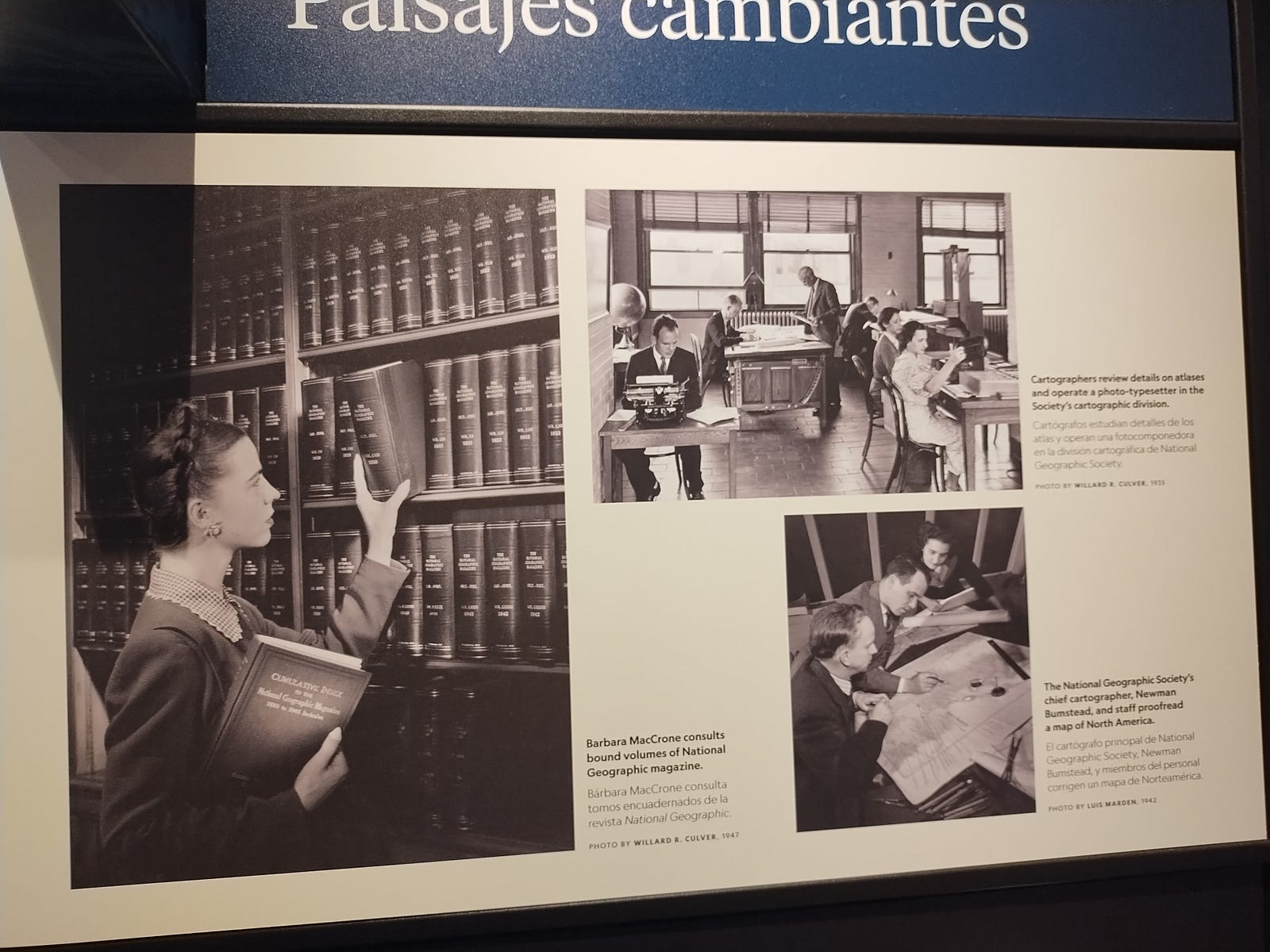
In the past 20–40 years, environmental protection and journalism during conflict have become more central to the brand. The grown-up exhibits tended to focus on these high points of NatGeo, including an art gallery room with large photos (famous ones such as "Afghan Girl" surrounding a temporary exhibit on the USA), a video about the impact of photojournalism, and actual cameras and gadgets used by official NatGeo Explorers.
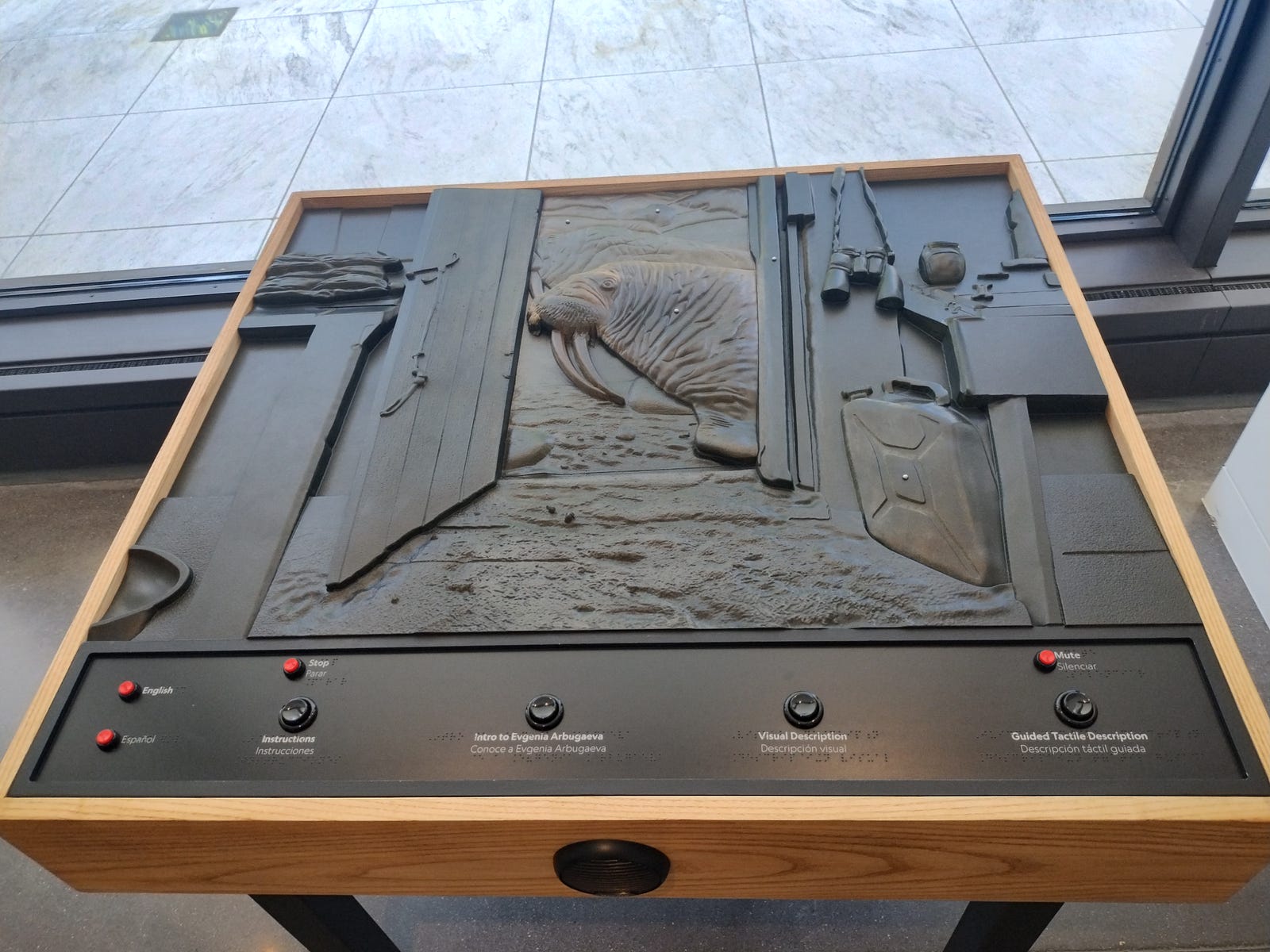
This panel for a photograph of a walrus seems like they wanted to try some things with accessibility, but I don't know how successful it might be.
The kiddie exhibits were mostly about animals and biomes, with the cameras room having a more accessible section about how stories get written and published. There were some wall-size screens, including Esri's "Geoverse" experience, which I can see class tours walking through.
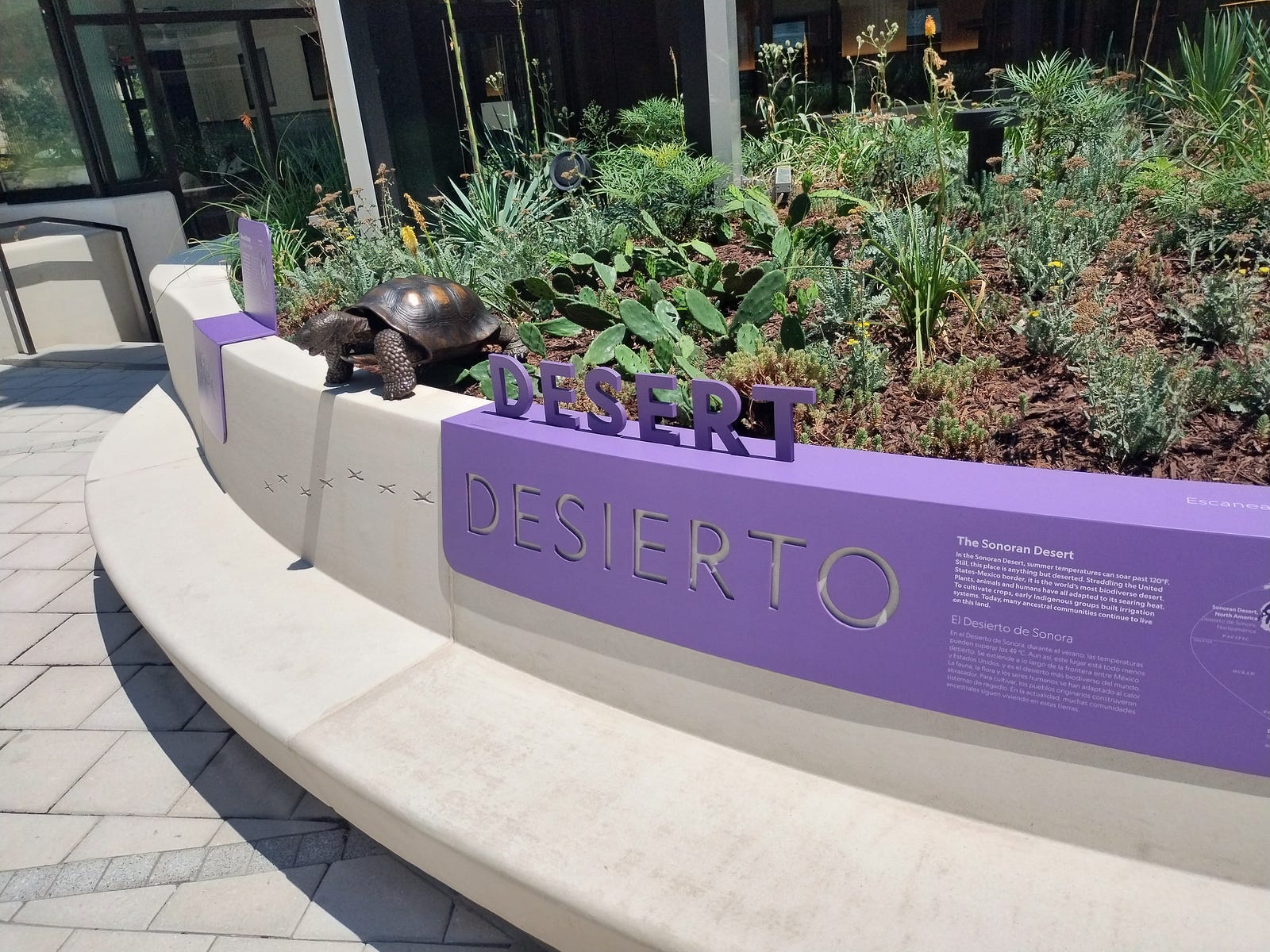
Everything, including the courtyard in front, was English-Spanish bilingual:
The atrium uses wood which is sustainable by their standard:
It was sourced from a New England family farm fighting the emerald ash borer - an invasive beetle. By using these specific trees for our millwork, the team helped the farm preserve their forest.
In their choice of exhibits, NatGeo was thinking about diversity, inclusion, and acknowledging past injustices. In 2017 then editor-in-chief Susan Goldberg published an article for an issue about "Gender Revolution" and then in 2018 reflected on the organization's racism (African-Americans were excluded from National Geographic membership until 1940). Sometimes this was acknowledged in sign text, or by including Hesolon Mukiri, one of Leakey's assistants who had been denied permits during Kenya's colonial period. Other times it was harder to figure out the intent (one display case includes a photo and bio of a modern researcher, next to a century-old diving helmet).
I'd recommend this to families, but it's good for NatGeo-inclined adults and probably designed to host corporate events in a couple of spaces.
Undercroft
When I heard that there was a new museum hidden under the Lincoln Memorial it sounded very cool. Wikipedia says that it was last open to tours in 1989. After a major investment, you can go through a secure area to look at columns through glass. They have a projection mapping show which talked about Lincoln uniting the country, and they are working on opening more space, but there isn't much down there. I'd expected to learn something about the construction of the Lincoln Memorial?
Ken Griffin had donated "early copies" of the Emancipation Proclamation and 13th Amendment, but in mid-July these were replaced with replicas due to high temperatures.
Read up on the ticketing system before visiting. They charge $1 to reserve a time online, but considering how few people are aware of the museum, you can likely walk in. I wasn't sure where to go and asked a ranger, but as you approach the entrance becomes obvious on the north of the steps.
The steps of the memorial were taken over by a Falun Gong protest that day.
National Museum of American History
I just walked by, but shout-out to them for adding the US territories to their flags in 2022. I don't think I'd ever seen the Guam and American Samoa flags before IRL.
Air & Space Museum
President Ford and astronaut-turned-director Michael Collins opened the museum just before the bicentennial. The museum has released a few podcast episodes about their history.
In time for their 50th anniversary, the Smithsonian renovated about half of the museum. In 2023, someone reached out to OLPC about them using a photo which I'd taken in the Marshall Islands in 2013. I quickly agreed to make it available. This was a candid photo of multiple kids looking over a computer at our launch event at Delap Elementary. I eventually found a higher-res image and other images from that day, but remained uncertain if and how they'd actually appear.
I first thought about this as a message to the future. This was a legacy of our project, already 10 years old. I honestly thought it was a bit weird - why choose this over the other photos from OLPC? Was it to check a box somewhere about Pacific Islander representation? Also while it wasn't staged for publicity, it wasn't super true to the experience of kids' day-to-day life in the Marshall Islands? Did a museum which has a moon lander and a replica Skylab expect this to be a slice of life though? Or just to say, this is a thing which has been accomplished.
After the exhibits reopened on July 1st, I remained a bit anxious. What if I hyped it up too much, and it wasn't there? I pictured myself straining to find it on a large screen, or a globe full of photos. Or a large photo with not enough pixels or context or claiming they used satellite internet or spelling something wrong.
A week before, while booking my trip, I watched a few videos of people touring the museum to guess where to look. It wasn't with the collage of people using tech around the "Living in the Space Age" Astroland sign. The first positive sign was it appearing in a blog post "What is the Space Age?" shortly before the opening. I considered, do I need to post something about being a nomad or crediting the Marshallese people or how it's going to be in the shadow of these rockets and sponsored by RTX (formerly Raytheon), I mean if you were partial to the idea that OLPC was a type of cultural imperialism, in this essay I will...
On the morning of my one day in DC, I got out of the Metro and walked to the south of the museum, which is no longer open as an entrance. You could see people around bringing young kids over; it felt very American. The museum has free timed ticketing. I joined a line wrapped around the block, which then got reorganized. Soon I was behind a group of kids from an "Unplugged" Christian summer camp.
When I quickly walked over to the exhibit, it took a little searching, but I found it in these rows of panels about disaster response, animal tracking, and other ways that satellites change lives.
There is a sort of indestructible booklet, which was already open to my photo page. This felt a lot more permanent than a video, and less out-of-place compared to the larger photo displays. When I saw the cover "Bridging the Digital Divide", it finally made sense why they'd looked up my photo.
I posted to the family group chat, and made a joke about leaving the book open to my page. When I came back, the booklet was closed and no one was around it (left, center):
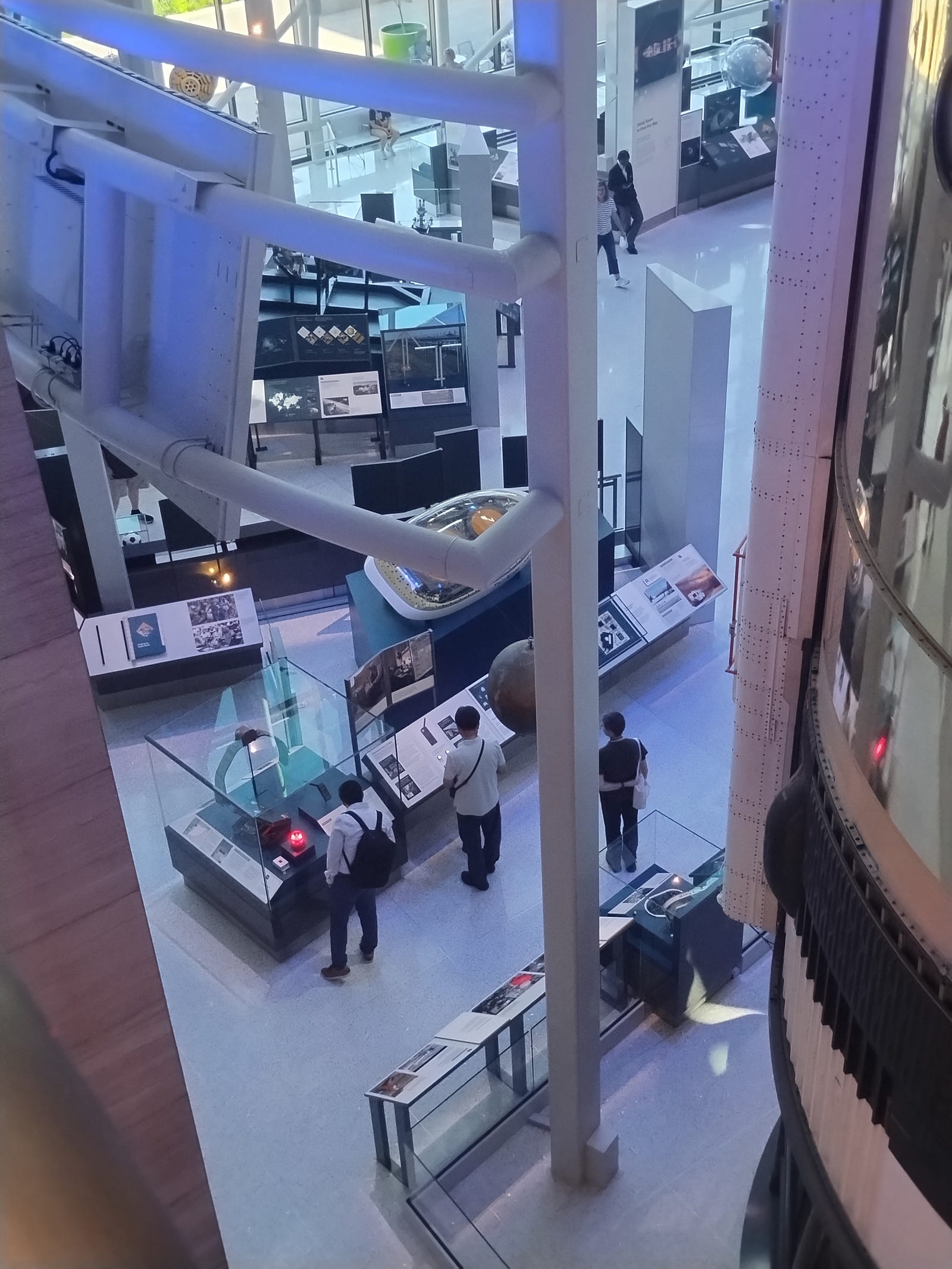
… but by the time I got downstairs, the book had been flipped to a chart. I almost left it on my page again, but decided that it belongs to The Public now, and left it on the chart.
As for other additions, I was struck by how the museum had reached out to Blue Origin, Virgin Galactic, SpaceX, Spaceport America, and drone companies for the new exhibits. The last shuttle flight was in 2011 so I should probably accept that this is the future. But you've got Blue Origin's suborbital rocket and capsule, Astrobotic's lunar lander which failed to leave Earth orbit, and snapshots of robots in space movies. Also Amazon drone delivery, which made me feel better about the non-representative-ness of the kids using OLPC laptops. SpaceX seemed underrepresented, but they haven't sent Dragon capsules to many museums yet. The next big renovation will be adding a Bezos Learning Center.
