Georeactor Blog
RSS FeedDayton Travel Blog
I was on the road, and made a short trip over to Dayton to cross some sites off my list. This ended up being kinda long as a postscript, so it deserves its own post.
A little intro to Dayton
I visited the Wright Brothers museum (Dayton Aviation Heritage National Historic Park), the International Peace Museum, the National Museum of the US Air Force, and Holbrooke Plaza.
Food-wise, it seemed like there were an unusual number of pizza places? Someone wrote a Wiki article about "Dayton-style pizza" in 2023, though it's mostly unchanged since then. I got a fancy beet pesto and artichoke pizza, and a "salmon reuben" sandwich, then later tried Indian and Thai takeout. On a cold Sunday morning I saw a line for Val's Bakery downtown, around the corner from a church supply and a vacant storefront. I went back before 8am on a Wednesday and a few other customers were also arriving.
Dayton's economy may have been strongest during the era of the Miami and Erie Canal. Thousands of people came through the city while their boat was in the locks. Railroads made canal travel less viable, and during a devastating flood in 1913 the government blew up the whole system. A Lyft driver, who recently moved there from Montana, complained that devastating tornadoes come through every decade or so.
Wright brothers and historical preservation weirdness
The month that the Wright brothers were taking flight, one of their rivals Samuel Langley was having pilots test a glider on the Potomac River while leading the Smithsonian. One story goes that this is what poisoned the Smithsonian bureaucracy against the Wrights, so they would favor and pursue other inventors' claims until 1942. As a side effect - or maybe in the shadow of Kitty Hawk? - historic sites in the west of Dayton, where the Wrights lived, did not get attention. In 1936, Henry Ford relocated the Wright brothers' childhood home and a bicycle shop to his museum in Michigan. Shortly after Orville's death (1948–1950), a Wright Flyer was restored for exhibition in Carillon Park south of Dayton. In the 1970s, a lab building was torn down for a project which was never built. There was an intention to preserve some part of the facade, but websites say that the bricks in storage got thrown away or repurposed (?), so the gate at the location today was built from new bricks.
In the 1980s, with the neighborhood on the brink of destruction, Jerry Sharkey purchased a lesser-known former Wright bicycle shop and began a campaign for national recognition. Huffman Prairie was landmarked in 1990. The National Historic Park was created in 1992, and their Instagram says that their "first interpretive ranger" started in 1996. The main visitor center was complete in time for the centennial in 2003.
I found the messaging around the park's multiple locations to be confusing (I didn't go to Huffman Prairie or Hawthorn Hill). You need a ranger to visit the bicycle shop. Websites describe a tour every hour on the :30, but on a Saturday morning I just walked in and a few visitors were looking around and questioning the ranger. You can see the bicycle exhibits in a few minutes.
The 2000s-era visitors center is more inclusive, and has some things to touch and pull, buttons to make some noise, not so many screens. There is a movie which takes 30 whole minutes (!), narrated by Martin Sheen, with cringe CGI. I later learn that Sheen is from Dayton (also Rob Lowe). I agree with a comment that the museum came too late to have any of the major artifacts. So there are a few tent pegs from Kitty Hawk, a print shop with some genuine type (no drawing or photo survives of their homemade printing press, so they have a mock-up with a sheet over it)… then some add-ons: a cash register and stepladder invented by other Dayton-ians, a guy's parachute collection (with a binder of newer parachute records), explanations of lift and drag, pitch and yaw for kids, a timeline of airplanes, a walk-through reconstruction of the grocery store below the print shop, and exhibits about Paul Laurence Dunbar.
An early Black poet and writer, Dunbar was a classmate, customer, and friend to the Wright brothers. After his untimely death from tuberculosis, his house went to his mother and then to Ohio for historical preservation. A document from 1988 describes difficulties with keeping the house open as a museum, as Dunbar faded from the community's memory and a highway separated the western neighborhoods from downtown. By this point the house was already included in the National Park proposal.
In 2005–2006, multiple Ohio representatives sponsored a bill to rename the park Wright Brothers-Dunbar National Historic Park, but it doesn't look like it got to the floor.
Some questions I walked away with:
- Why did the print shop and bicycle shop change locations so many times? Was that normal back then, or were they bad businessmen or bad tenants?
- The brothers' bicycle shops were open from 1892-1909. Five bicycles are in museums today (including the Air Force and Carillon Park museums here in Dayton). A park ranger said that they only made 300 bicycles, which seemed awfully unsustainable to me (3 / month?). Maybe I don't know the economics or they did repairs or were selling other models and accessories.
Online many people copy a sentence claiming that it was 300 bicycles per year. Who's right? The Smithsonian says:
During their peak production years of 1896 to 1900, Wilbur and Orville built about 300 bicycles and earned $2,000 to $3,000 a year
The sentence can be read two different ways, but at $40–65 apiece, we can get the figure of 50 bicycles / year.
Both sides of Third Street are decorated with sidewalk plaques for many famous Daytonians. I learned about Phyllis Bolds (whose marker has the iconic B-2 bomber, weird to see as a historic thing) and was surprised to see a plaque for Thomas Midgley Jr., the infamous inventor of leaded gasoline and Freon.
Peace Museum
The International Peace Museum was founded by a couple who were "long-time peace activists" and "farmers". One article says, "they lived on a Soviet Union collective farm for six months". They are connected to Church of the Brethren, an Anabaptist pacifist church. A pamphlet says this is the only permanent, brick-and-mortar Peace Museum in the US.
Entering the current location on the first floor of an office building, the vibe was alternative bookstore / Scouts meeting. It's open only two days per week. The staff were preparing for a documentary screening (a Palestinian artist discussing the flag used by the Ottomans to surrender Jerusalem to the British, now at an Ohio county museum). The museum has also hosted events around race, unity, and historical peacemakers (relatives of Martin Luther King and Gandhi).
There is a small room of activist art, and a section explaining NATO and where it has intervened around the world.
The draw for me was, of course, an exhibit on the post-Yugoslavia three-party talks which concluded with the Dayton Agreement. Artifacts include press passes, posters, a menu from a French restaurant. The museum explained a little how Dayton was chosen, and an exhibit on the later consequences explained Serbian interests in Kosovo, better than any books I had read. There was an exhibit on a courageous Bosnian newspaper: Oslobođenje. During the conference, Albanian-Americans came to the fence to shout at Milošević. An American representative suggested they could walk over and have a discussion, which Milošević shut down.
In 1999, Michael Ignatieff wrote in the New Yorker:
Dayton brought peace to Bosnia, but it perpetuated an American illusion about Milosevic that, while he was an unprincipled liar […] he was someone Americans could do business with. The success at Dayton led them to believe that they had the measure of the man.
[...]
We allowed ourselves to believe a cheerfully cynical scenario: that we would pretend to bomb Milosevic, and he would pretend to resist, and then a deal would be struck
Doing some background searches online, I would recommend the declassified Secret History of Dayton for extreme international relations wonks. Or GIS wonks (I had heard a little bit of this before, but the document has more about the tool in vogue at the time, PowerScene).
The paper links an October 1995 NYT article with speculation on where negotiations could take place. Camp David was symbolic for good and bad reasons. New York could lead to a major protest or a drop-in to a TV studio (Sacirbey, Bosnia's Foreign Minister, did leave the base and tell journalists at a hotel bar about his plan to resign). Clinton did not want to be present, but also wanted to keep options open. A military base would need to house up to 500 people. Dayton's base was appealing because there were identical facilities for the visiting parties in a quadrangle which could be isolated from the outside world for three weeks.
A 2025 interview with John McCance had a few more details about attempts to make Dayton a recurring event. A quote attributed to Bruce Hitchner:
If we pushed it a bit harder, we could have gotten to the point of basically positioning Dayton as Davos for the Balkans
In December, the German network DW News made a video "Was the 1995 Dayton Peace Agreement doomed to fail from the outset?" which takes a bleak look at the economy and lack of cooperation
I had not realized a) that Holbrooke was walking into Dayton feeling a need to research Carter and Camp David, b) that the Israeli PM Rabin was assassinated while the talks were ongoing, and c) a major point of contention was international administration of Sarajevo. "Secret History" suggests that Milošević was willing for Sarajevo to be fully Bosnian, but possibly to gain other territory or to undermine Bosnian Serb leaders.
Ambassador Holbrooke died in 2010. There's a Holbrooke Plaza northwest of downtown with US and Bosnian flags. A Google StreetView from December 2015 shows the concrete poured and flagpoles. The flags are in every image after, and I saw them early on a Wednesday morning, so you might be able to see them 24/7. I mapped the area on OSM.
Air Force Museum
I learned about the Museum of the US Air Force from jokes after a Transformers sequel scene was clearly not filmed on the National Mall (actually filmed at the Udvar-Hazy Center in Virginia). Dayton has the only B-2 on display, the only remaining XB-70 Valkyrie, and the B-29 which dropped the bomb on Nagasaki.
They were also hosting a mini-drone race THROUGH a C-124. Whoever organizes this has put effort into making this a spectator sport, with bright LEDs, and pilots' VR views displayed on a big screen. This and a drone show that I saw in Utah have each raised my P(doom).
I don't know if you've ever been to one of these big hangars of old planes, but after an hour or so my attention was fading.
I begin spending more time on any non-plane oddities which the museum had on display. Uniforms from Iraq and Afghanistan, a dress from a concert at the museum, a video about being called to shoot down Flight 93, two 'supercars' custom-built by Air Force recruiting and parked under the B-2. I would absolutely listen to a podcast about the objects which the team has collected.
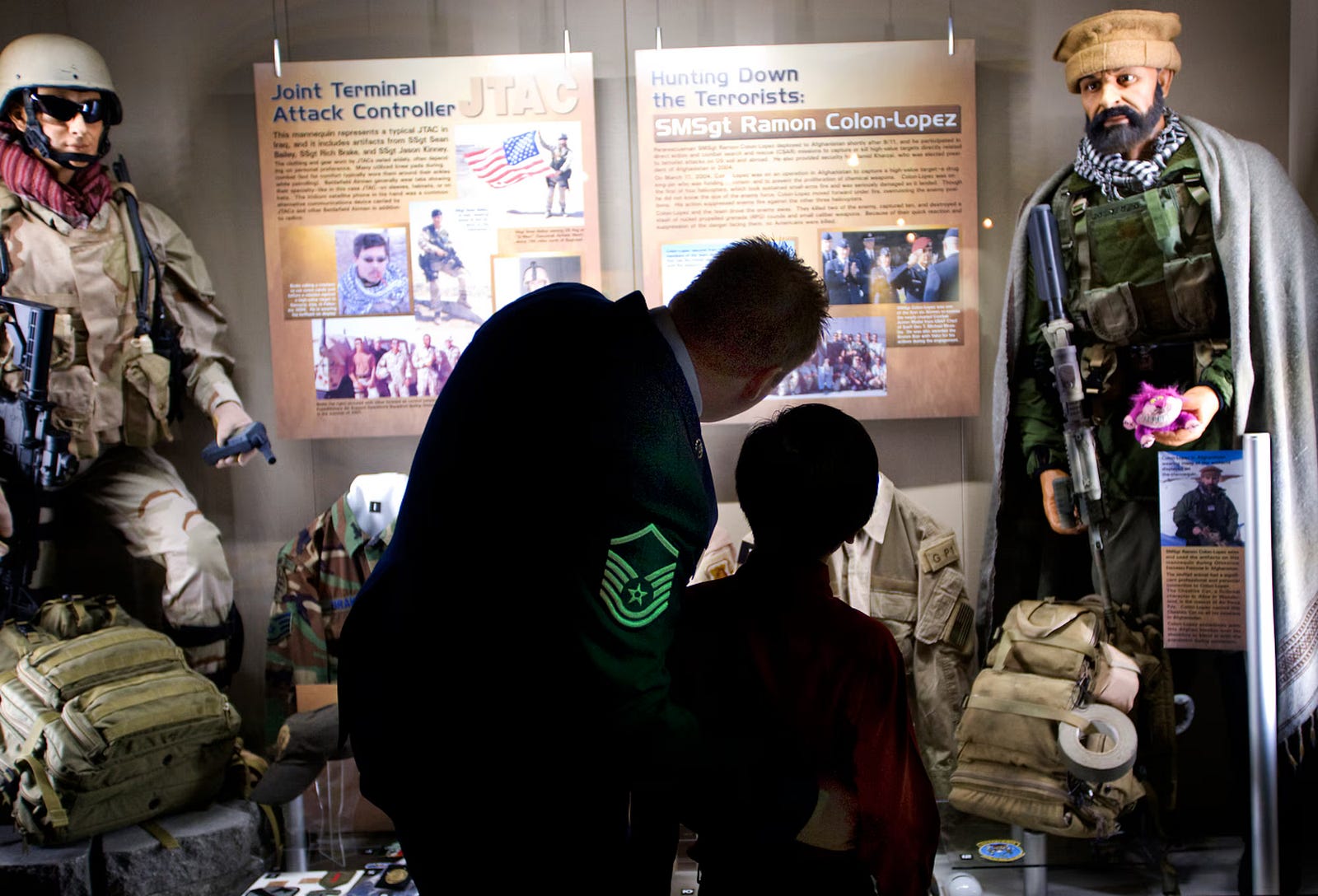
image that I found googling
Previous Reads
Superhero book + opera, mentioned in the New Yorker, but gallery not visitable w/o tickets https://gagosian.com/news/2025/09/21/super-duper-metropolitan-opera-lincoln-center-new-york-exhibition/
The pinball subreddit had a debate about "Project Pinball", a nonprofit which collects donated machines and puts them in children's hospitals. The OP was complaining that only 83 machines have been placed, and people were digging into the IRS Form 990, but other claims were quickly debunked (connections to a pinball museum). As best I can tell, what we're learning is that it's expensive to maintain dozens of pinball machines around the country and to employ people full-time. A lot of nonprofits have to keep fundraising because they do something weird and unsustainable like this.
In interesting media concepts, a play titled "Yoko's Husband's Killer's Japanese Wife, Gloria"
Another Day of Life: disturbing movie of a Polish reporter during the Angolan civil war (during the 70s, so he was more aligned with the communists), part rotoscope story, part documentary with the actual people. I didn't particularly get the movie or buy that one Polish journalist's choice moved the world, but I haven't see any other movie like it. Wikipedia says that Kapuściński's news reports have held up but his longform work and books (particularly one on Ethiopia) are not holding up to scrutiny by modern scholars with local knowledge.
In a Reddit discussion of the "Crungus" monster existing across early DALL-E type image generators, someone mentioned "Loab" and many replies said its existence was entirely made up by one artist. The Wiki article never hints at anything wrong? A more recent variant is Elara Voss, a name which some LLM or LLMs suggest for characters.
