Georeactor Blog
RSS FeedMarch 2026 read
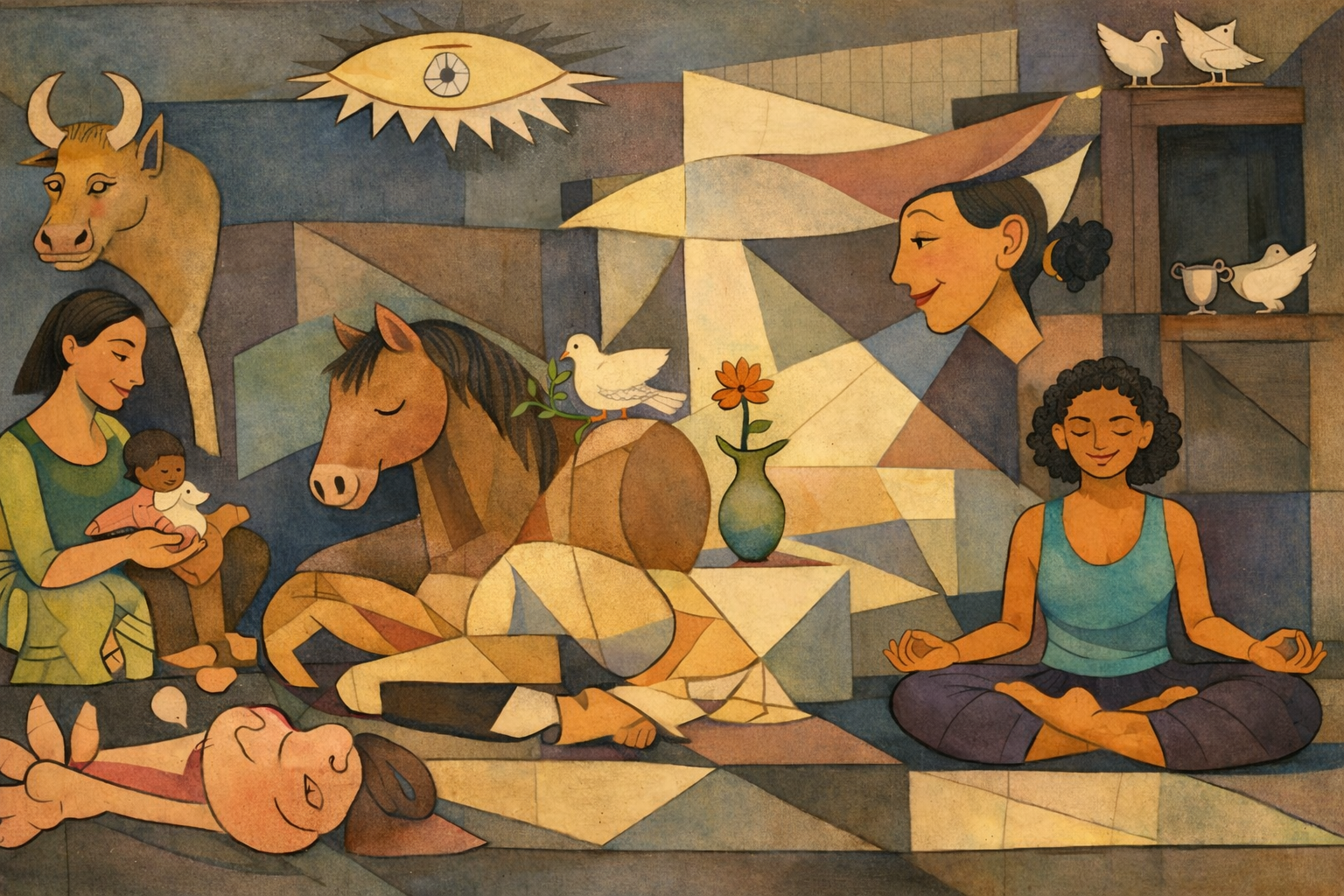
Thanks ChatGPT for allowing me to prompt this cursed image.
Guernica: The Biography of a Twentieth-Century Icon (Gijs van Hensbergen, 2004)
Where the previous read started with international athletes and leftists and got into the details of the International Brigades and tactics of war, this was an interesting journey into the world of artists and the Spanish diaspora. The Republic had decided at the last minute that the 1937 International Exposition would be an opportunity to engage with other countries and remain defiant in the presence of a large German pavilion. Picasso was commissioned to paint a giant canvas.
In the aftermath of Guernica, Picasso was urged to make the even his focus. The Basque representatives were baffled by the result (one story has Picasso telling the Basque president "they're not fingers, they're cocks") and thus they preferred an artist from their region, but others embraced it.
The author describes the dilemma that Spaniards were facing in taking sides during the war (the left had not done a great job of governing, and was not favored to win the war), and that the US and UK's neutrality was seen as only delaying the conflict with fascism.
From an art history perspective, the painting is connected to a few of Picasso's previous works, sketches, and other inspirations.
By the time Guernica went on tour in the UK, fundraisers had shifted from supporting the Republic's troops to assisting with the refugees of the war, now gathering in southern France. Negrín, the Spanish Republican PM, accompanied the painting on a ship to the US, where it went on tour again before finding a home at MoMA.
Picasso's life in occupied France has been subject to many stories and rumors. There is no definitive answer why he didn't take up offers to leave Europe ahead of the war, why some Spanish antifascists were handed over to Franco or arrested, while Picasso was censored but continued living free and producing art. Art historians (particularly around a 1990s exhibition Picasso and the War Years) agree that he was neither a collaborator nor a particularly notable resistor.
Regardless, the war lifted Picasso's image in the US. In 1939 people had protested that SF-MoMA was showing a communist's work, but by the time Paris was liberated in 1944 his survival was reported in the San Francisco newspaper, and Allied soldiers flocked to his studio.
Chapters about the American artistic and political post-war responses to Picasso and Guernica were a bit difficult to go through. They do point out some links to Jackson Pollock and how one of his giant drip paintings would ultimately replace Guernica at MoMA.
Leaders such as Truman and the Pope warned that modern art should be rejected, starting years of Cold War influence schemes in the art world. In the Red Scare of the 1950s, museum labels stopped directly invoking the Spanish Civil War, instead positioning Guernica as generically anti-war. Picasso's Massacre in Korea and awarding of the Lenin Peace Prize made his stance on American policy clear.
After 20 years of rolling, transporting, unrolling, and stretching the Guernica canvas, restorations around 1960 led MoMA to stop touring it and to coat it in wax resin and varnish. As Franco's censorship of culture moderated and his physical health weakened, Museu Picasso could open in Barcelona in 1963. By 1968–69 there were emissaries who made it known that Guernica and Picasso would be welcome in Madrid, but here the author takes the side of skeptics, that this was more likely unserious, a tactic to antagonize exiles or improve Spain's image. Picasso went to a lawyer to ensure his painting would be held back until the Spanish Republic returned.
I appreciated the book going over the steps which led to Guernica's return. Though MoMA's director and Picasso's widow expressed interest in embracing the new Spain shortly after Franco's death, there were still highly publicized crackdowns on free expression. Then-senator Joe Biden put forward a resolution in 1978 to return the painting (this apparently stuck with Biden, as 15 years later he would talk of "Srebrenica becoming a new Guernica").
Going into 1981 the final details had been resolved with MoMA and Dumas (Picasso's lawyer), and even the attempted coup that February did not derail their plans. Guernica would spend years in an extraordinarily secure exhibit, which the author describes quite negatively, before the painting was finally moved, while stretched, to the Museo Reina Sofía in 1992.
Currently it is on display with South African artist Dumile Feni's African Guernica.
Notes
Around 2017, the museum made a gigapixel scan and a Leaflet-powered zoomable image of the canvas.
They have a short video about the project, and related art and documents: https://www.museoreinasofia.es/en/multimedia/rethinking-guernica
The final pages of the book cover requests from prominent museums in Japan, Barcelona, and of course Guernica and Bilbao. The Guggenheim was reportedly designed with a place for it, and the Basque government just made a request to display it for the 90th anniversary of the Guernica bombing. It seems unlikely that the museum's art conservation staff and the national government will be open to it; they have allowed mostly sketches from Picasso's time planning the work.
Last November, Ukrainian President Zelenskyy visited the museum with Spain's Prime Minister. The German president also visited the painting and the town of Guernica last year.
The author, Van Hensbergen, is Dutch and studied in the UK and US, but has become an expert on Spain, writing books about the Sagrada Familia, Castillian cuisine, and the Spanish Civil War.
- I didn't know about Picasso being appointed director of the Prado Museum in exile (so, in name only), and I hadn't thought about the difficulties of evacuating paintings during a civil war.
- This book, the Wikipedia article for "Guernica", and Basque government use a number of deaths circulated at the time (1,645). The Wikipedia article "Bombing of Guernica" cites a BBC article that 200-250 were killed, and casts doubt on whether there was a heavily-attended market day. It's something which I remember reading years ago and it's troubling that it hasn't gotten closer to a resolution.
- The author researched bombings on civilians which had begun to occur outside Europe. Though Guernica made this fear real, there was a building sense throughout the interwar period that another war was inevitable, and that chemical warfare or bombings would cause mass killings of civilians in cities.
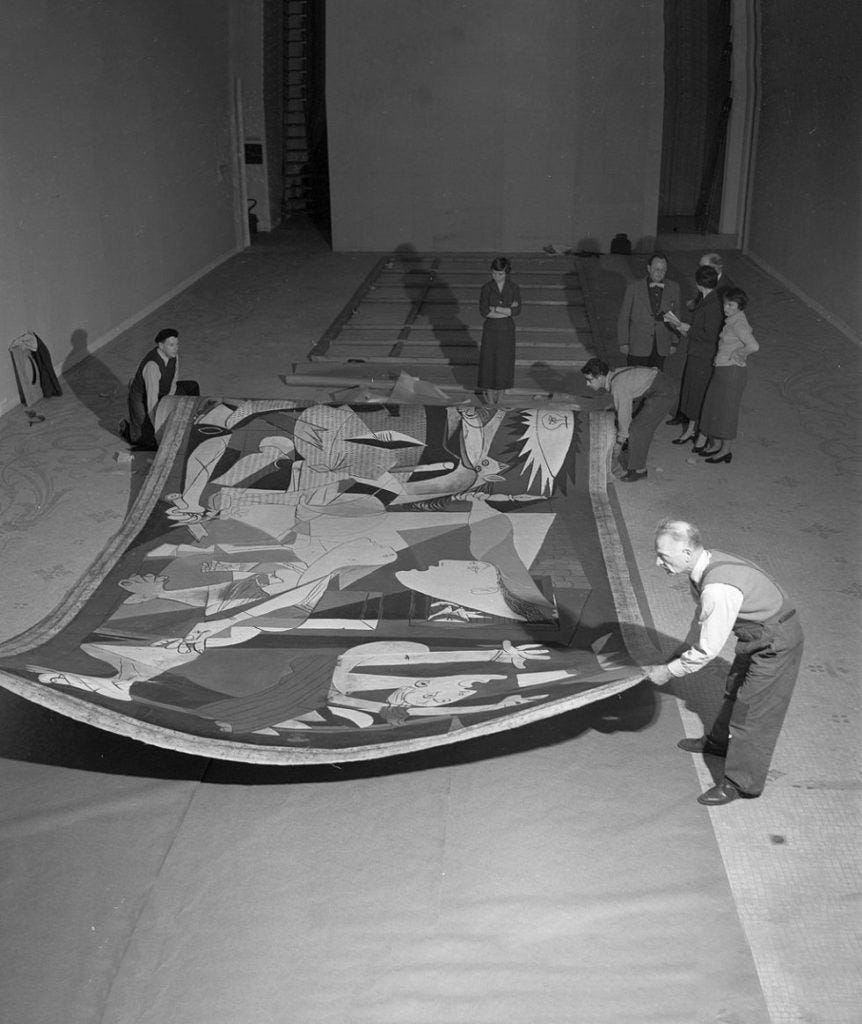
While I was reading, online I saw a photo of the painting being stretched onto a canvas, which just makes the whole enterprise feel fragile.
I hope to visit the museum in the near future.
Previous Reads
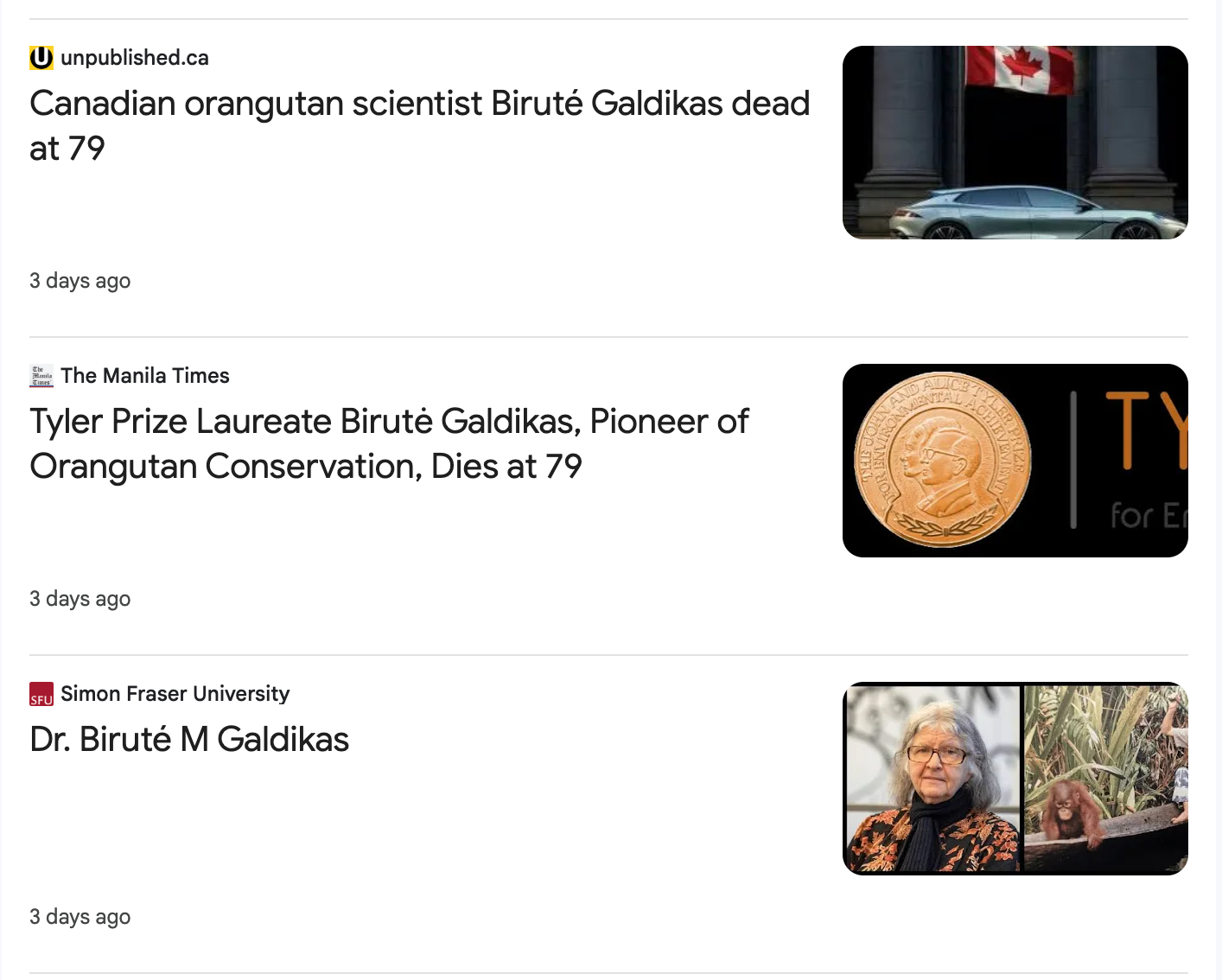
Dr. Biruté Galdikas, the last of Louis Leakey's official "Trimates", died on March 24th. She will be buried in Borneo. Sometime after I moved her article title to Biruté in October, other editors restored a few Lithuanian "ė"s and the article opens with the incongruous "Birutė Marija Filomena Galdikas or Biruté Mary Galdikas".
The first high-quality articles appeared in Lithuanian/Baltic news sites, so this and Wikipedia ambiguity most affected sources downstream who hadn't written about her before: https://news.google.com/search?q=galdikas
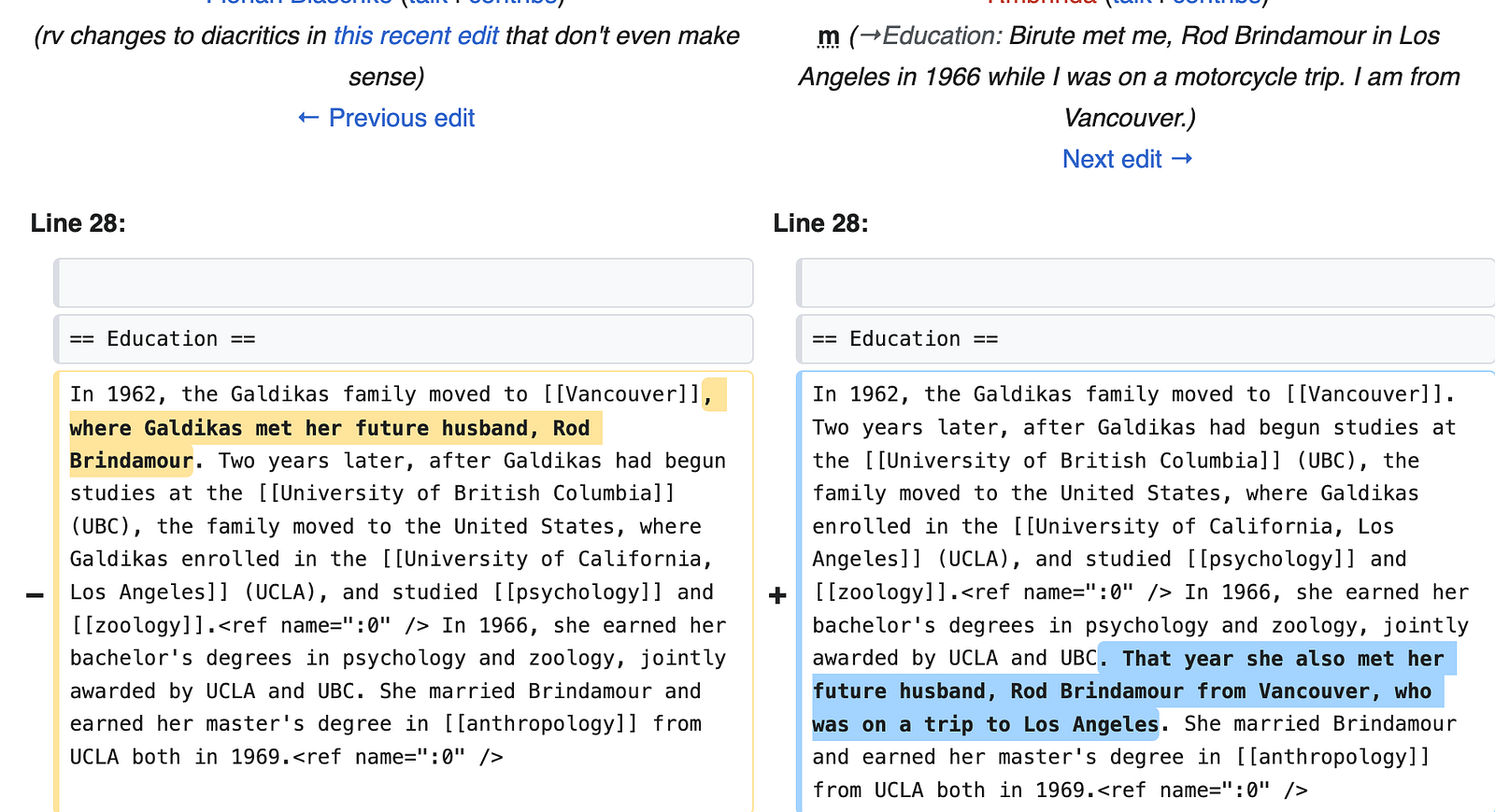
I also noticed that her ex-husband edited her Wikipedia article to clarify how they met (not NPOV, but let's keep it).
A podcast mentioned this bizarre movie about a female Supreme Court justice, First Monday in October, which was accelerated into theaters when Sandra Day O'Connor was nominated. https://www.youtube.com/watch?v=f9vhFEweovc
Using chalk to remember victims of the Triangle Shirtwaist Fire, in the NYC neighborhoods where they lived: https://blprnt.medium.com/the-hard-work-of-remembering-e34b8161d519
I didn't watch Sinners but after it won Oscars, I heard about two cultural rabbit holes which Ryan Coogler rolled into the movie:
- Dolly Li talks about her AJ+ documentary about Mississippi Delta Chinese got noticed by Coogler and led to being hired as a consultant; the same series had an episode about Gallaudet University's student campaign for a Deaf president, which is now a documentary.
- From the Bechdel Cast review of Disney's The Luck of the Irish, Coogler described Oakland kids becoming curious about Irish culture through the DCOM
Saw an Instagram Reel by a woman whose parents were from Soviet Uzbekistan. They had to limit practice of Islam growing up, and with their daughter's help, they've become more religious by engaging with the wider Muslim community in NYC.
Someone in the comments claimed that Islam came to Java through Uzbekistan. Indonesians responded with some confusion, but it looks like they're referring to Malik Ibrahim (who some believe had the family name as-Samarqandy).
