Georeactor Blog
RSS FeedAFK Post April 2026
Science and Tech and Game Theory
Michael Pollan has a new book on consciousness (after psychedelics someone got really into existential philosophy and brain stuff, so special), and listening to his interview on 'A Slight Change of Plans', he ALSO went down a rabbit hole on the 'plant neuroscience' community.
Cloudflare continues to lead in technical blog posts about post-quantum encryption / cryptography (PQE or PQC). They plan to be fully ready by 2029.
Google's latest research also got to the bottom of rumors about cryptocurrency.
And I haven't seen Meta blogging about this before, but they have a roadmap / case study written up.
SweepTheStrait.com is a Hormuz-shaped Minesweeper game. I spent hours on this recently. First I appreciate a detail of Minesweeper, which is if there's a 50-50 pick of a mine or a safe space, at some point you have to click and it cannot get any easier or safer if you spend time somewhere else on the puzzle.
Also I had not thought about the difficulty of an irregular-shaped Minesweeper before. Consider a 1D linear Minesweeper, where you know to skip a cell that you know is a mine, but you have no info if the next cell down the line is a '1', '2', or a mine. If you're going to play this game 100s of times, you should start with the line in the northwest each time to avoid wasting time on normal sections.
If the top proprietary AIs are working with the military, they use the models before real attacks, and the military can push the industry around if they hit safeguards… is AI safety already over? What were all of the lectures and books and Effective Altruism hot takes supposed to prevent? (Side note: I wonder if EA discourse, including the "Claude Constitution", led to some of the rhetoric around the US Constitution during the Anthropic-Pentagon controversy)
Then I was surprised to see the Middlebury Institute post a lecture on Gemini doing war games. I can understand why the military might test this to harvest new ideas from this or future LLMs, but I am puzzled about the claim of 750 simulations, 1.3 million words, etc. I would think after 10 or 100 simulations, the marginal value can't be that high. Either your superintelligent LLM can meaningfully predict archetypal nuclear war timelines, or it is writing randomly, or we're saying that nuclear war is so unpredictable that 100 different scenarios don't cover it.
Media
Netflix has a 5-episode miniseries Radioactive Emergency about the Goiânia radiation incident (scrappers took a radiation source from an abandoned hospital). I learned a lot from this, even though it's not strictly nonfiction.
A neighborhood works together to keep up an unauthorized, non-waterproof Conan O'Brien plaque: https://www.sfgate.com/la/article/conan-obrien-plaque-22014116.php
I watched a new interview about the Zodiac movie (2007). The movie follows Robert Graysmith's books from 1986 and 2002, ending with multiple people believing that Arthur Leigh Allen was the killer. Also in 2002, a DNA sample failed to match Allen. That's mentioned in the movie epilogue, but I think most people remember Allen.
True believers say that this sample was from the face of the stamp, so it would be contaminated. Considering how forensic genealogy and trace DNA have improved since, including the arrest of EAR/ONS in 2018, I'm surprised that there haven't been announcements. Or at least an expectation that families provide a DNA sample before they do a Zodiac suspect press conference.
Amazon Prime has a series "Bait" about Riz Ahmed being considered as the new James Bond. Is this the kind of series that needed the Broccoli family kicked out of creative control, or is it just a coincidence that Amazon has this? I was interested in the concept, but there is a lot of chaotic energy and awkwardness, difficult to binge as a casual thing.
While I was looking up what else I've seen Ahmed in, IMDB showed me that he just played Professor Snape in 2025's Harry Potter audio play. In addition to everything else wrong with continuing the media, Stephen Fry has had a story since ~2016 about recording the original audiobooks.
The Miniature Wife has a lot going on with mental illness and family patterns, while mocking couples therapy. Maybe it will get picked up in the cultural zeitgeist. I thought they had a innovative way of showing the 'mad scientist' husband thinking about ideas and passing the work to members of the team. There was no big computer, just people coming up with ideas and checking each other's work, to convey expertise. The writers also thought through comparisons to Downsizing and Ant-Man (the original short story precedes both movies).
Chaotic bilingual duet of two Claire performers from "Maybe Happy Ending": https://www.youtube.com/watch?v=R5OFG8EQVl8
TrueAnon podcast watching "Shen Yun" with research, and still not knowing what is going on exactly https://www.youtube.com/watch?v=SzzQkblfF3Q
I was thinking about the 2000s-2010 internet, and how you could find full movies and TV shows before copyright was so restricted, and mash-ups of Star Wars with musical theater or weird series like "Chad Vader"… One of the artifacts of this was YouTuber Lilly Singh going by "Superwoman" for years, until relaunching her personal brand in 2019.
I saw a lot of movies from the American canon which I wouldn't have sought out, and now I listen to a bunch of movie podcasts. I don't think these movies would be as available or discoverable if I were growing up with HBO Max or something.
Midwest
The Milwaukee Public Museum is relocating five blocks north and rebranding as the Nature & Culture Museum of Wisconsin. The city subreddit has some complaints about iPads and fears for the fate of dioramas and walk-through exhibit "Streets of Old Milwaukee". https://www.mpm.edu/mkerevealed
Chicago school IDs will work as library cards https://blockclubchicago.org/2026/04/08/chicago-turns-all-public-school-ids-into-library-cards-to-boost-student-access/
Artemis aside
The Artemis 2 astronauts and mission control had paragraph-long scripts around every major milestone. I found this to be annoying! Although there have been many comments about Neil and jokes about humans messing up their first words on the Moon or Mars, I don't like that it removed any pretense that the astronauts were going on mike to say what they were thinking or feeling.
I was surprised to discover that Wikipedia is still hedging on "one small step for [a] man" when I'm pretty sure this was settled before I was a kid. In August 2025 someone gave the "one small step" speech its own Wikipedia article, mostly to expand on this controversy and duplicate information from Neil Armstrong's page.
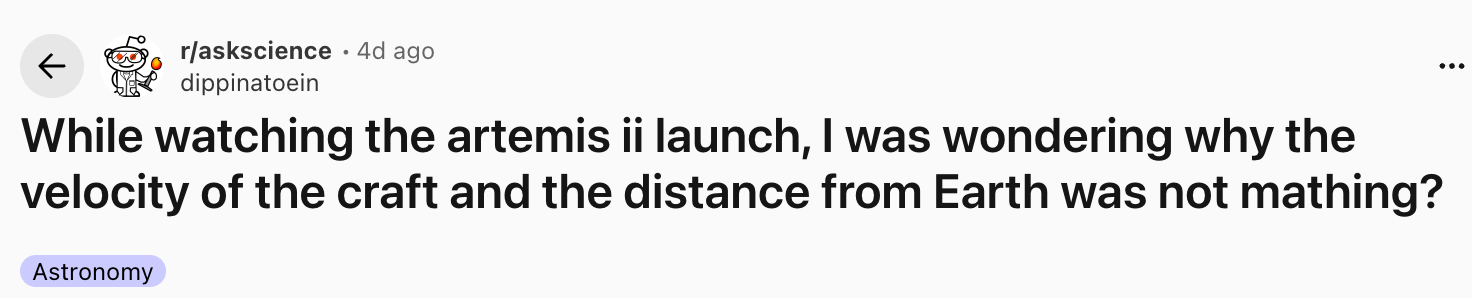
Unfortunately, responses to the mission have revealed just how little people remember about spaceflight. First it was a question about not going straight up into space …
Then as Artemis left Earth orbit, an astronomy PhD candidate posted about this 'first' for women in space. Admittedly it is not spelled out in the post, but people in the replies could not understand what she meant.
Some replies shared photos of women on the ISS, but others… seem to think that NASA has never had a woman astronaut until now?
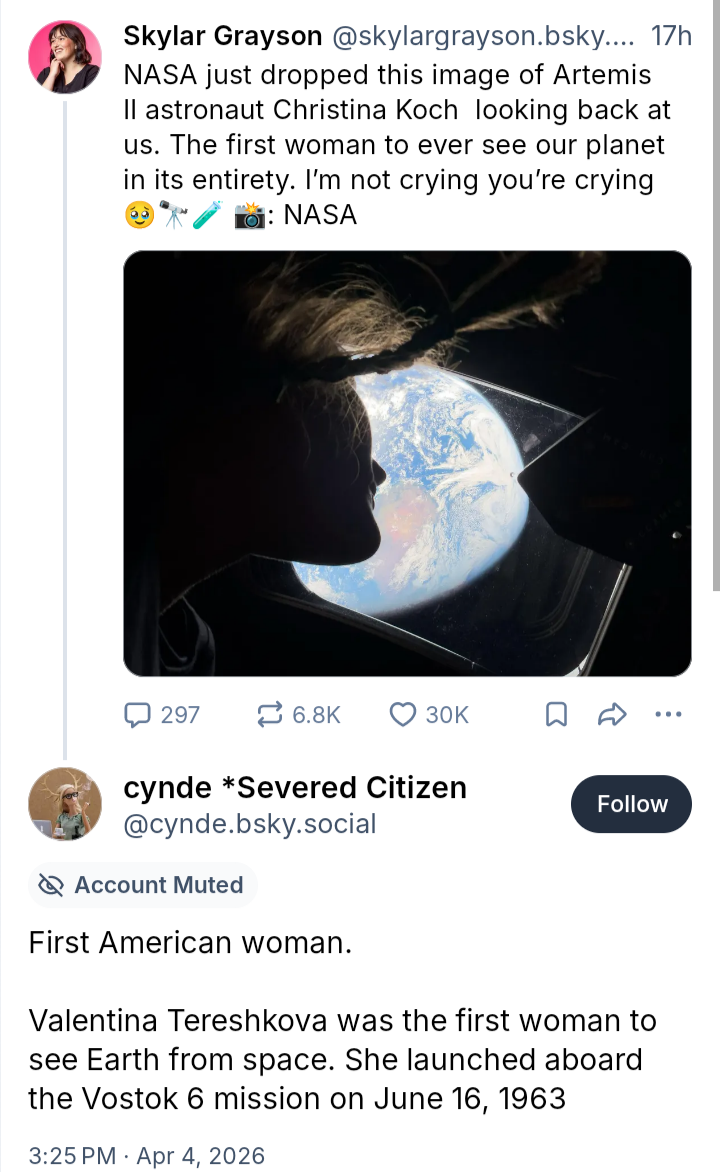
Multiple people mentioned Tereshkova.
Stranger still, another person seems to think Christa McAuliffe would have been the first woman in space:

Also shout out to this person:
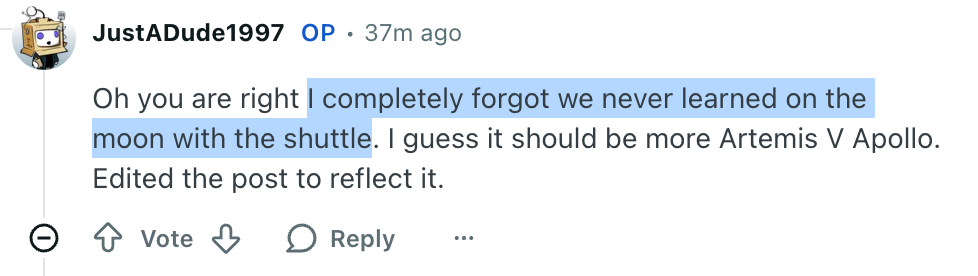
If I was going to make this into a whole cultural whatever, I don't think that we spent a lot of time learning about the shuttle in school (in elementary school we watched Apollo 13 but probably because it had just come out on VHS). Deep details on air, space, cars, and dinosaurs are often spread among kids who memorize things about them, and age-level books which target these interests. Are there other topics like this?
